A New Englander at heart, Dan is a sports contributor for Heavy.com covering the New England Patriots primarily among other sports. He has written for the Boston Globe since 2014 with a focus on local sports, and has contributed to SB Nation, FanSided, Inside Hockey, New England Soccer Journal, and WEEI. Follow him on Twitter @DanielRShulman.
Walking out of the small five-terminal airport and into the desolate, cold night, the stench of fresh air hit harder than the brisk breeze of early spring. Waiting 15 minutes for the nearest Uber to come pick us up allowed for enough time to let our surroundings sink in adequately. The American flag flying high above the driveway affirmed we were somewhere that no longer felt like the United States.
“So, this is Fargo, North Dakota?” my partner Chris said reluctantly.
“Never imagined I would come here,” I quipped back.
In fact, standing on that shoddy airport sidewalk was the last place I imagined myself on a Thursday night in March. The previous Sunday, when the Boston University hockey team learned its fate and was being shipped out to Fargo, I was met with frustration and disappointment.
“It’s not fair!” I thought. After all I was a senior and I wouldn’t be able to see BU play live again. I had covered the team for three seasons and would not be present at the most important juncture. To make matters worse, BU was playing North Dakota just 80 miles from the latter’s campus, so the outlook was grim.
On Monday, life returned to normal. Studying for an exam I had coming up on Thursday night, I was interrupted by a phone call from my broadcast partner, Chris.
“Hey, so I got this email, we need to meet up now! BU is sending us to Fargo.”
The brief exchange left me with more questions than answers. Upon talking with the dean of our college at BU and our professor Frank, we were being sent on an all-expenses paid trip to Fargo to broadcast the tournament.
With logistics taken care, we set out to Fargo, a city devoid of high-rises, traffic, and thankfully, wood-chippers.
As we got into our Uber to the hotel, our driver summed up our generalizations of this region with a strange introductory question.
“So, what brings you boys to Fargo? You like to drink ’cause there’s lots of that here? Not much here else really.”
Chris and I exchanged a shell-shocked glance before he hesitantly answered: “Well, yes, but we came from Boston for the hockey tournament out here.”
Safe to say, there was no more conversation during that ride. Thankfully checking into our hotel, preparing for a busy day Friday, and sleeping were all extremely smooth.
The next day began early for us as it was game-day. Still groggy from our nearly cross-country flight less than 12 hours ago, Chris and I awoke, showered, and grabbed continental breakfast before heading back to our room. It occurred to us that we had yet to look at our surroundings in the daylight so we opened the window.
Over the course of a minute, we witnessed a lynx sprint past our window, a jam-packed curling club across the street, and a barren wasteland of power lines and tall grass still yellow from winter.
With nothing else to do but head to the rink, we set off two miles away to Scheels Arena.
The game was one of the best things I could’ve ever witnessed. The cacophony of 6,000+ screaming fanatics clad in green, white, and black cheering on North Dakota was unlike anything one could ever imagine at a sporting event.
But the game. Oh, what an awesome game it was. Four-and-a-half hours of pure hockey action complete with a thunderous check that shattered one of the panes of glass, a double-overtime game-winner from BU, and an eight minute goal review that aged each of the arena patrons an extra eight years.
BU won 4-3. So we celebrated. After we got in the Uber back to the hotel, we informed the driver of our plan.
“Any way you can stop by the nearest packie?” we asked. Our driver obliged.
We drank, watched college basketball, and began prep for the next day’s game against Minnesota-Duluth. But when it came time to eat, we found a cozy bar called Golf City. It was a bar with golf simulators and people dressed in full golf outfits with fully-equipped golf bags were playing the night away.
The food was alright but the experience even better. And the boss, who ended up being on our flight home, gave us free drinks when we came back the next night.
The next morning, while eating breakfast we sat with one of the opposing player’s parents – to say it was a harbinger would be an understatement. That same player, Adam Johnson, scored the game-winner that night.
Leaving Fargo that Sunday morning as day broke over the Great Plains, I couldn’t help but think about the whirlwind week that was. An impromptu trip to Fargo might not be everyone’s idea of a weekend well-spent, but it certainly provided one of the best experiences of my life.
The town of Plymouth in Southeastern Massachusetts is best known for being the first site pilgrims set up a colony in the new world. While many tourists flock to Plymouth Plantation and the Mayflower, several other historic details about Plymouth are left unknown to many.
‘Captain John’ boats at the Mayflower Pier features an hour-long Harbor Cruise aboard the Pilgrim Belle, a remodeled paddle-wheel boat. Step aboard the historic vessel and embark on a tour of Plymouth Harbor.
The narrated tour of the harbor is informative and fun while the return leg back to the pier features a variety of beach music allowing all passengers to enjoy the summer sun while on board.
One of the crew members, Alex Corcoran, is a student at Plymouth State who has always been fascinated by colonial history.
“A lot of what we learn in elementary school about the pilgrims is fabricated,” she said. “I love working on this tour because it disproves all those preconceived notions.”
One of the first points on the tour is Plymouth Rock. While the site is commonly identified as the first place the Pilgrims landed in America, the tour disputes that. Provincetown, as it was aptly named, was the original landing spot, though the Pilgrims found it uninhabitable with infertile to plant their crops.
So on they went. Eventually landing at Plymouth. But it was not all smooth sailing for the Pilgrims as 52 of the 104 passengers forced to stay on the boat during the winter, perished while another was born. Scurvy, tuberculosis, and pneumonia were among the diseases that threatened the Pilgrims.
“A lot of people who come on our boat think the Pilgrims arrived in America and were home free,” Corcoran said. “That’s one pleasure I get from this job, being able to teach people about real history in a cool environment.”
Many of the landmarks within Plymouth Harbor were named by the Pilgrims, a prime example being Bug Light. The light juts out of the water to mark a dangerous shoal for ships to avoid. Corcoran, now narrating the tour, explains how it’s called the Bug Light because pilgrims would often catch lobsters off this spot. Unfamiliar to English waters, lobsters were referred to as “bugs” by the settlers.
“It’s the kind of stuff they don’t teach you in history class,” Corcoran said. “You get an insight into the way things used to be in Plymouth. It’s interesting to hear about the origin of things.”
As the Pilgrim Belle turns around at the tip of Long Beach to head back to port, snacks and drinks are offered and music fills the loud speakers. The hits from Jimmy Buffett, The Beach Boys, and Bob Marley fill the deck on the boat with, as Corcoran puts it, “good vibes.”
“This element of the tour makes us unique,” she said. “Typically on a harbor tour you’re just sitting there listening and looking. We make ours interactive as well as enjoyable. There’s nothing better than being on the water in the summer listening to ‘feel good’ music.”
As the sun beat down and the cool ocean breeze blew, the old vessel came into port, releasing its passengers with an updated knowledge of the area. Unlike most harbor tours, this is one Corcoran believes is worth taking again.
“We get a lot of people who come back and take our tour each year,” said Corcoran. “They like the relaxed nature of it.”
As I got off the boat, I was even offered with a friendly suggestion for where to find the best lobster roll in the harbor area. Corcoran suggested Wood’s Seafood…and it was A+ fresh and excellent quality.
The city of Boston can be slightly overwhelming for visitors and residents alike. Towering buildings stretching high above envelop the serpentine streets below.
Boston’s Harborwalk provides an excellent escape from busy city life and a window into the past city and present splendor of an old American city. Numerous people choose to take this path less traveled by.
Looking back at the reflective glass on many of Boston’s high-rise buildings, the old city rises in front of the new. Looking down State Street from the Harborwalk along Long Wharf, viewers are provided with an unobstructed view of the Old Statehouse. One block down is Milk Street which connects Central Wharf to Downtown Boston. From the end of Milk Street, the spire of Old South Meeting House sticks out among other shiny, new buildings.
On Central wharf, behind the New England Aquarium, sits a portion of the Harborwalk that provides majestic views of Boston’s harbor. Sailboats float at anchor inside the harbor, ferries to Charlestown and the Harbor Islands drift by, and planes freshly in flight roar above like the sound of waves crashing against the rocky coast.
This serene, peaceful escape sits at the edge of a bustling, boisterous city and provides a place for the weary traveler to sit and collect their thoughts while taking in the true beauty of Boston.
Finding this slice of paradise is simple; leaving is whole lot more difficult. As you pass the sea lion tank in front of the aquarium, follow the ice-cream-stained brick pathway as it turns into a wooden dock, around the corner of the aquarium sits chairs and benches fastened to the pier.
Take a moment to sit and experience.
The sound of water flowing up against the dockside creates the illusion of sitting on a tropical island. Seagulls land in the water with a caw, a boat exits the harbor with a small toot of its horn.
The sun reflects colorfully off the water and beats down warmly on the faces of those seated along the wharf.
The salty, sea air fills the nostrils of any passerby and creates the feel of the beach.
It no longer feels like the middle of Boston.
Another plane soars overhead, full of adventurers embarking on a journey to an unknown destination. The jets pass so close you can clearly read the name of the airline on the side and get a perfect view of the logo on the tail. For aircraft enthusiasts alike, it’s a hidden gem in the city where planes can be viewed from an intimate angle.
On the opposite side of the airport, a line of lights across the sky become visibly, with each glowing, white dot growing larger by the second. The wings of a plane arriving in the city come into view just as another takes flight.
Looking to the left on Long Wharf, across the bay from the airport sits the Old Customs House. Before the days of flying contraptions and metal ships came old wooden ships crammed with immigrants from across the ocean optimistic for a fresh start.
Presumably, the first place they went was the Custom’s House. Before entering the big, gray building, a look out from the dock towards the ocean presented a different view than the one today albeit with the same effect.
Come, sit down behind the aquarium and take a gander into the great, blue beyond. Do you feel that sense of hopefulness? It’s similar to what immigrants felt centuries ago, and what those who stop for a moment feel now.
The city of Boston is the perfect destination for historians. Whether you’re trying to observe some of the many landmarks along the freedom trail, dine at one of America’s oldest restaurants, or attend a baseball game at Fenway Park; Boston has it all.
But for sports historians, the city’s roots lie deeper than just a pilgrimage to Yawkey Way. Throughout the city, there are three historic sites which hold a special place in Boston sports lore – Nickerson Field, Matthews Arena, and the Cy Young statue.
A trip to Boston for ultimate sports fans wouldn’t really be complete without a trip to these three locations. All four of Boston’s major sports franchises got their start at one of these places as did the Atlanta Braves organization.
The journey begins with a quick trip on the Green Line B-Branch to Pleasant Street. While a shiny, new Agganis Arena gleams at the street corner, down Harry Agganis Way appears an ivy-covered grandstand. Towering over the BU Police Station is the final remnant of Nickerson Field, once home of the Boston Braves baseball team and Boston Patriots football team.
The current police station building was formerly utilized as the team offices with a pathway to the field carved out under the stands. Behind the police headquarters sits Braves Plaza. During Nickerson’s heyday, trolley cars flooded this area dropping off fans ready to cheer on the hometown team.
In the early 1950s, the team moved away leaving the stadium abandoned. But in 1960 a new American Football League team, the Boston Patriots, moved in for its first three seasons in existence. Since then, the stadium has been home to soccer and lacrosse franchises as well as BU athletics.
While the trolleys have made way for the rat-race of Boston University students, the plaza contains a plaque dedicating the former site of the Braves and Patriots. The lone seating area remaining served as the right field grandstand during its baseball days and the concourse remains primarily untouched since the Braves left.
Hopping back on the Green Line, the next stop is along the E-Branch at the Symphony station. Nestled on St. Botolph Street just across from Symphony Hall, is Matthews Arena. Now the home to Northeastern ice hockey, the 107-year-old building once served as the original tenant for the Boston Bruins and Boston Celtics.
The arena has been renovated since its days as a professional arena, but the vestibule and lobby remain primarily the same as they were when the building opened. Inside, the lower seating bowl has been updated with improved chairs and a state-of-the-art media center.
The building, albeit modernized, still shows signs of its age. The wooden roof and steel rafters cavernously overhang the rink below. The upper deck hangs low over the bottom bowl, providing obstructed views for several fans in the back rows. Up top, the ends remain free-standing areas for fans to congregate and hang over the edge of the ice.
Reminders of its past tenants still beckon as banners dedicating the Celtics and Bruins hang in the arena. But those two teams weren’t the only pro teams to occupy a spot on Northeastern’s campus. Just up the road sits the former site of Huntington Avenue Grounds, the first home of the Boston Red Sox.
Though the stadium itself is long gone, a statue of Red Sox legend Cy Young is placed appropriately on World Series Way behind Northeastern University’s Cabot Center. The Red Sox won the 1903 World Series at Huntington Grounds and played there through the 1911 season before moving to Fenway.
The Cy Young statue is situated right where the pitcher’s mound was at Huntington Grounds. 60.6 feet away in the courtyard is a bronze plaque of home plate jutting out of the grass with an encryption stating how the first ever World Series was played at the site.
The final commemoration on the site is 350 feet from the plate on the side of the Cabot Center where a sign marks the location of the left field foul pole.
Not just perfect for Boston sports fans, these three destinations, all within walking distance of each other and accessible by public transportations, present a slice of history. From the World Series to the Stanley Cup and even the NBA Finals, these three sports mausoleums are places where avid fanatics and history buffs should definitely visit.
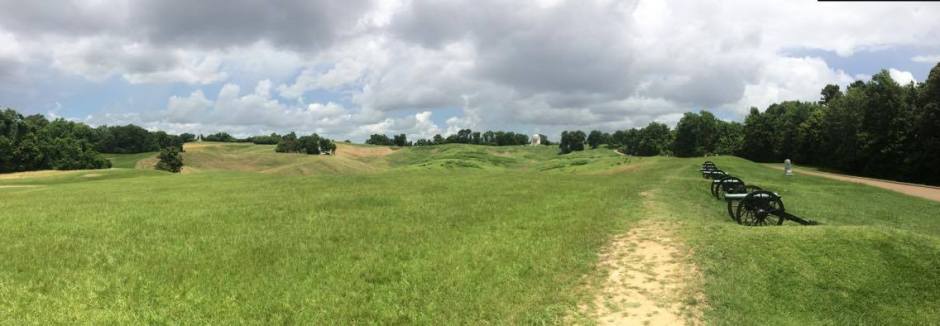
Standing on the grassy hillside, overlooking the furrows of a once great battlefield, witnesses stand captivated. The sheer expanse of the plain below them, the multitude of cannons and great monuments beside them, endlessly rolling skies above.
But the most awe-striking feature of a once chaotic and boisterous lea is the absolute silence. Save for a passing breeze or rumble of thunder, the hallowed grounds where Civil War generals once presided over armies of young men slaughtering compatriots, sites of vast death and Northern glory, the eerie silence is what immediately captures one’s attention.
This is Vicksburg, Mississippi.
The small port city on the banks of the Mississippi river was once the site of a territorial battle between Union and Confederate troops to control the shipping lanes for much of the region. One of the most crucial turning points of the war occurred in this former metropolis, now sparsely populated adjacent to Northeastern Louisiana farmland.
It’s difficult to be prepared upon entering a battlefield as large as Vicksburg. Will there be evidence of carnage? Is it haunted? Must we be quiet out of respect? The answer to all those is yes.
Following a breathtaking, almost-inspiring view of the whole battlefield, the truck rolled down the one-lane road toward the first site: a circular colonnade with an open roof. As dark clouds began to fill the blue horizon, ducking into the memorial building to escape the rain became required as torrential downpours swept through the fields.
The mysterious, neoclassical building is the Illinois State veteran’s memorial. Inside, the echo of a voice can carry for almost five seconds, ringing to the top of the dome before being spit out the top like a bullet. Very symbolic of the horrors that once happened on the battlefield below.
Even the smallest whisper carried like a scream from a slain soldier. While alone in the building, a tug on the back of one’s shirt leaves questions unanswered. Is this simply a breeze circulating or is it the ghost of a soldier reaching up as a final plea to be saved from death? Not sure.
The continuous cruise through the battlefield eventually led to a large, old battleship protected beneath a tent. It’s easy for something of this size to catch one’s eye, but across the road is something bigger and even more impressive: a cemetery.
Small gravestones and markers as far as the eye can see, devoid of names for the soldiers who lay eternally beneath. The stones were marked with a number. Nearing the exit, a small gazebo atop a hill inside the cemetery beckoned.
A windy pathway to the top of the hill leads visitors to one of the more incredible sights in the park. From inside, the entire gravesite can be seen, much larger than any old wooden ship. A truly hallowing site indeed.
As the trip around the grounds came to a close, one of the final sites came right where the two sides signed a peace treaty. A small cannon jutting upward from the dirt and grass with a simple description. Across from a house overlooking the field, one can pay their respect for the dearly departed who sacrificed so America could prevail.
Opposite from the hillside where the journey through the site began, several deer have now flocked to the ridge as the storm clouds cleared. Truly, the weather on this fateful June afternoon was a microcosm of the battle and the war itself.
From the outset, storm clouds billowed overhead. As the rain fell, the journey went deeper into the battlefield. Much like the war seemed to be swirling into a storm of uncertainty around the time of this battle, the weather continued to deteriorate.
But as we arrived at the site of the truce, a glimpse of sunshine brightened the valley. On that same sight in 1863, the light at the end of the long and arduous tunnel that was the Civil War began to come into view.
Before departing, a visit to the Vicksburg gift shop felt necessary. Inside, books, replica artifacts, and postcards could be found. One book, Uncle Tom’s Cabin stopped one group of tourists who remarked how it was offensive to place that particular title in the history section when it should be with other fiction novels.
This rather disparaging comment took the air out of the sails of a life-changing day. At a place where armies fought to eliminate such an attitude, racism and inequality somehow continued to exist.
Turning out of history and back into the present, the truck trundled through the gates and back onto the highway. Thoughts swirled around like the wind outside.
What did the battlefield look like in the midst of fighting? I wonder if the reaction from the soldiers was also to find cover from the storms that passed by each day?
On Friday June 23, 2017, the Boston Red Sox retired David Ortiz’s iconic number-34 in an efficient ceremony on the field. What many saw on television and in person was a seamless celebration featuring a myriad of moving parts.
But behind the scenes, Fenway Park assistant security director Mark Cacciatore was hard at work ensuring the ceremony ran smoothly.
“Any time something happens in the ballpark – whether a regular tour or a game – we’re involved,” Cacciatore said. Everything that happens in the ballpark, we’re required to have a hand in it.”
It is not just Cacciatore’s responsibility to facilitate special events like this ceremony, but to help oversee everything happening at Fenway.
“You definitely look forward to nights like this,” Cacciatore said of Friday’s festivities. “You’re at the park, you might as well enjoy it, keep busy, and see some cool stuff too.”
LOCAL ROOTS
Mark Cacciatore grew up in Waltham, a short 15-minutes from the stadium. From birth, he was a Red Sox fan and remembers going to games throughout his childhood and as a young adult.
At age 34, going to Red Sox games became more than a recreational activity. As an employee for Fidelity Investments, Cacciatore grew tired of working a typical day-job.
Looking for a new, more adventurous job, Cacciatore decided to apply for a day-of-game staff position.
“It’s something I sort of fell into,” Cacciatore said. “A friend from my town was working there and asked if I’d be interested.”
Sure enough, he got the job. His first duties were as ticket taker and usher before being promoted to supervisor and later assistant director of security. Rising through the ranks, Cacciatore has always loved where he works.
“It’s been great,” he said. “It’s a non-traditional job. You’re not sitting at a desk for a 9:00-5:00 type thing; it’s a lot more hours. You see a lot of different things you’re not exposed to.”
CH-CH-CH-CH-CHANGES
Working in a 105-year-old building named a historical landmark
Following the events of September 11, 2001, security at Fenway and all venues across the country changed forever. Any fan with a bag would be subject to more stringent checks at the gate to ensure prevention of a terrorist attack.
12 years later, security became even tighter when terrorism struck far too close to home during the Boston Marathon bombings.
“Of course, after the marathon bombings, we went to all metal detectors [at gates],” Cacciatore said. “More equipment is being used: walk-through metal detectors and handheld metal detectors. We were doing some form of that prior to 2013. But when [the marathon bombings] happened, every person coming in goes through metal detection.”
New metal detectors installed at Fenway’s Gate B have helped make the stadium safer. (Photo by Dan Shulman)
The heightened security presence is noticed by many fans, including Alex Crane. The Minnesotan was in town for the week while his team visited Boston and was impressed with the extra measures taken at the gates.
“It definitely makes you feel safe knowing the extra precaution has been taken,” Crane said. “It’s thorough and organized and the risk of something awful happening is no longer there.”
Crane, who said Target Field in Minneapolis took similar measures during the 2014, noted that the Red Sox go above and beyond in making Fenway safe.
“The stadium scoreboard showing the code of conduct, security guards helping you find your seat, it’s really special how this stadium makes you feel welcome.”
GAMEDAY!
Typical weeknight Red Sox games begin at 7:10 p.m. For Cacciatore, his day begins ten hours earlier. At 9 a.m., Cacciatore arrives at Fenway Park and heads to office, checking emails and looking over incident reports from the previous game to research trends are problem areas in the ballpark.
This early preparation allows Cacciatore to staff different areas of the park and address problems to ensure they do not happen again. Various meetings and researching accompany this preparation.
As afternoon approaches, players begin to arrive at the park for workouts and batting practice. On the security front, activity begins to pick up.
“Around 3 p.m., it starts to get busier,” Cacciatore said. “There’s a lot more people around the park and a lot more radio calls and questions being answered.
“We find our time researching what’s going on inside the park that night and responding to game day staff questions about the day’s events.”
With the game approaching fast, gates are opened 90 minutes before first pitch and fans begin to swarm inside. However, Season Ticket Holders and Red Sox Nation members have been in the park for an hour at this point.
“Anywhere in the seating bowl is open during BP,” Cacciatore said. “You can only go where you have a seat from 5:30 p.m. onward but there are no restricted areas.”
One of the busiest times over the course of the whole day for Cacciatore and the security staff at the park is the on-field pre-game ceremonies. After years of facilitating what is now a well-oiled machine, the ceremonies, according to Cacciatore, pretty much run themselves.
Fans get ready to enter Fenway Park for a game in 2012 before metal detectors were istalled. (Photo by Wikimedia Commons)
“It’s pretty well-organized,” Cacciatore said. “We know ahead of time where people are going and they’re escorted by our staff.
“It’s all about communication. Guys that we have up in the office are consistently updating the staff about when people are coming in.”
With the ceremony underway on the field and the game anxiously approaching, Cacciatore and his crew are manning the gates to supervise the staff as fans flood Fenway concourses. But when the game begins, things drastically slow down for Cacciatore.
“We get a chance to look at the operation and a few of us sit up in the command center behind home plate to get a full view of the field. This way if a call comes in, we’ll be able to see it from there and on CCTV.”
When the game ends, Cacciatore makes sure the staff stays in place and the park is vacated. Security guards inspect all corners of the stadium to prevent trespassing. With the crowd usually dispersing within an hour after the final out is made, Cacciatore briefly reviews reports and discusses incidents with his staff before he heads home.
INCIDENT CONTROL
If you attend any event at Fenway, you’ll see several employees walking around the park with navy blue polo shirts and walkie-talkies. Posted up in every section and at every vomitorium throughout the stadium, these staff members are in charge of keeping Fenway an enjoyable place.
Even when the park is dormant, the security department ensures Fenway Park and the area around it are safe.
“In addition to the 81 games and other auxiliary events that go on inside the park, we’re responsible for 24/7 security here at the park,” he said. “Making sure nobody gets in the park at night. A lot of camera work but also research after-the-fact. Trying to find out what happened if someone did sneak in or someone’s car was broken into on the street.”
Various different incidents take place over the course of a game which involve security to intervene. During the past weekend series against the Los Angeles Angels, section 36 experienced a medical incident involving a sick fan.
A woman, presumably intoxicated, was removed from the stadium by ballpark security and paramedics after vomiting. She was led away by security personnel, one of them being usher Tom Grogan.
“Occasionally, we’ll see rowdy fans,” said Grogan, who has worked in section 36 for a decade now. “Sometimes ticketed fans in this section tend to enjoy themselves a bit too much sometimes and it leads to things like this.
“We’re told to diffuse every situation in a calm manner without causing drama. What happened here was a perfect example of that.”
SOUND OF DA’ POLICE!
For bigger incidents of misbehavior, the Boston Police are often called upon to help not only with crowd control, but with apprehending and punishing offenders.
During high profile games like David Ortiz’s number retirement or even bigger stages like the World Series, heavy police presence is noticeable.
Walking to the ballpark during the 2013 World Series, the street was lined with cops on horseback and empty patrol cars parked along the sidewalks. Although the streets smelled like manure, there was order.
Inside the park, police only intervene for select incidents such as fights in the stands or when a person runs on the field.
“We don’t handle runners,” Cacciatore said. “BPD handles that and charges the person with disturbing an assembly. As for fights in the stands, our guys step in first and then BPD arrests any involved party with a charge of disorderly conduct.”
Even outside the park, it’s important for Fenway Security and Boston Police to remain vigilant in making sure fans are safe and, of course, no one is breaking the law. Every day presents a unique challenge – like August 18, 2015.
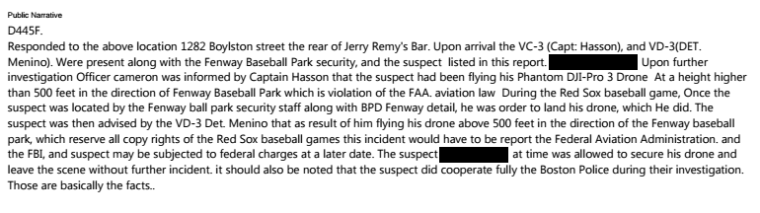
The Red Sox were playing the Indians late in the season and Eduardo Rodriguez was having a career night on the mound. High above the diamond, a drone was overhead taking footage of the game in progress. Police were alerted to the “aircraft incident” and forced the owner of the drone to land it.
An excerpt from the Police report of the above incident, obtainedattained through a public records request, reveals details of the incident. (Clipping by Dan Shulman)
The offender was in violation of FAA regulations as the drone was flying above 500 feet. The operator also faced federal charges from the FBI as Red Sox games are copyrighted by Major League Baseball.
It just goes to show, you never know what mightmay happen at the ballpark.
HARD WORK PAYS OFF
Almost every day of the year, Cacciatore is inside the park attending meetings to discuss the day’s events. Rain or shine, summer or winter, Cacciatore is always working to keep Fenway secure.
As a lifelong Red Sox fans, Cacciatore relishes the opportunities to watch his hometown heroes each night at work. During the 2013 World Series, Cacciatore and his staff maintained order at Fenway Park on baseball’s biggest stage and during a year where vast changes to security protocol were abound.
Lo and behold, the Red Sox won the World Series at home for the first time in 95 years, and Cacciatore was on hand to witness a historic event.
“Obviously my favorite day on the job,” Cacciatore said. “Seeing the World Series when they won that, being involved with that, and traveling with the team all over.
Perhaps even more rewarding for Cacciatore is seeing the many great shows and concerts at Fenway Park each year.
“Even more rewarding is seeing some of your favorite artists,” he said. “Like Bruce Springsteen and Jimmy Buffett, dealing with their security people and meeting them.”
Though some days might not go according to plan, for Cacciatore, it’s hard to have a rough day when working a job you love at America’s Most Beloved Ballpark.
“Things do get hectic here,” he said. “You got people pulling you in all different directions.
“Some days are crazier than others but no day is ever a bad day at Fenway.”
This past week, the Senate Intelligence Committee continued its probe into investigating Russian interference in the 2016 Presidential election.
Although Donald Trump ultimately won the election, votes in many of America’s major cities, especially Boston, were vastly in favor of other candidates. The Fenway neighborhood was one of Trump’s worst showings, with the Republican winning just 9.54% of the vote in that ward.
Several constituents in the area already were unhappy with the results of the election. Now, with the scandal of election tampering coming to light, some Bostonians are bitter about the whole situation.
“I’m upset about it because it makes me feel like my voice wasn’t heard,” said Maureen Bennett, who voted for Clinton in November. “It’s as if my vote never counted.
“It doesn’t matter because this isn’t what I asked for and now it turns out it may have been tampered with.”
While waiting at the Kenmore Square bus stop, Rita Brown, also a Democrat, said she didn’t think it was fair that “Trump has gotten away with it.”
“It seems obvious to me that he tampered with the results, and now people who had nothing to do with it have to deal with the consequences,” Brown said.
Then, there are Republicans in Boston who feel as if the President is simply being targeted.
“I feel like the media is just accusing people before evidence is presented,” said Andrew Carlson, who voted for Trump???. “That’s leading to the case, not facts.”
Carlson, who is registered as an independent was waiting for the bus to take him back to his apartment in Longwood, said he is unsure of past election results given the election tampering. The situation rings alarm bells, Carlson said, and now he is unsure of past election results.
“I’m concerned about our national security,” he said. “Who’s to say this hasn’t happened before? We need to ramp up security.”
Some members of the Libertarian Party who live in Fenway also said they are disappointed with the election and the president.
Although Gary Johnson collected a paltry 3.37% of the vote in the Fenway neighborhood, some, like Massachusetts College of Pharmacy student Alicia Hackett, feel his platform was run with more integrity than both Clinton and Trump.
“Does America really seem great now?” said Hackett, a student at the College of Pharmacy.
“As far as [election tampering] goes, it’s sketchy and a breach of justice not to investigate,” she said. “It sure sounds like Comey has a lot more evidence to back up his story than Trump.”
Not only has the election come under scrutiny from disgruntled voters, but the way the situation is being handled now also has incited anger.
“This whole thing is being handled poorly,” Bennett said. “Trump is still President and until then; it’s not being handled right.”
Some Boston voters like Rita Brown are convinced that this investigation was inadequate yet remain unsure of the perfect solution.
Hackett, meanwhile, was quick to point out other inconsistencies about Trump.
“Let’s talk about the [expletive] he’s spewing about cutting off ties with Cuba because they’re communist,” she said. “But Russia is still his best friend — Russia is literally going through scandal now for oppressing in so many ways”
Regardless of political orientation, many said they think that some form of punishment must be given to anyone found responsible for the tampering.
“If someone knew about it they should be punished,” Carlson said. “Just because it was in Trump’s favor doesn’t mean he should be punished if he didn’t know about it.”
As the investigation presses on, many in the largely Democratic community in Fenway said they feel despair.
“I really hope there are changes,” Bennett said. “I’m still worried about what happen.
“I just don’t have any faith that whatever happens will be good.”
 Daniel Shulman